Diarylethylamines
What Are Diarylethylamines?
Diarylethylamines are compounds containing two aryl groups associated with an ethylamine framework. In discussions of dissociative substances, the name usually refers to selected 1,2-diarylethylamines, including diphenidine, methoxphenidine and ephenidine. These compounds can inhibit NMDA receptors despite having a different molecular framework from ketamine and PCP.
The discussion here focuses on the dissociative members of the family. Other diarylethylamines can have different pharmacology.
Diphenidine, Methoxphenidine and Ephenidine
Diphenidine contains two phenyl groups and a piperidine nitrogen within its overall framework. Methoxphenidine is commonly used to mean 2-methoxydiphenidine, also abbreviated to 2-MXP. Ephenidine has a different nitrogen substitution and is known chemically as N-ethyl-1,2-diphenylethanamine.
A methoxy group at the 2-position produces a different compound from one at the 3- or 4-position. An abbreviation such as MXP can be less informative than the full chemical identity, particularly when analytical reports or informal descriptions use names inconsistently.
These compounds attracted attention within the wider discussion of new psychoactive and research chemicals. Their appearance in that context did not mean that controlled human studies had already established their effects. Much of the useful early evidence came from analytical chemistry and experiments on receptors and neural tissue.
Evidence for NMDA Receptor Inhibition
In a 2016 investigation of diphenidine, methoxphenidine and related compounds, researchers combined receptor binding with functional experiments. Diphenidine and methoxphenidine inhibited NMDA-mediated signalling and also altered a measure of sensorimotor gating in rats.
Sensorimotor gating is the filtering process studied, for example, by measuring how a weak preceding stimulus changes an animal’s startle response. It does not directly measure the animal’s subjective experience or establish a particular mental state in a human.
Ephenidine has also been examined using electrophysiological recordings in rat hippocampal tissue. It inhibited NMDA receptor-mediated responses while leaving the tested AMPA receptor-mediated responses comparatively unaffected. The experiments also found inhibition of the induction of long-term potentiation, a form of synaptic strengthening involved in models of learning.
Interference with synaptic signalling provides a plausible basis for acute cognitive effects. Lasting injury would require evidence of persistent changes after exposure, which these experiments were not designed to establish.
Other Receptor and Transporter Interactions
A study of monoaminergic interactions found that diphenidine and methoxphenidine also interacted with monoamine transport systems. Their profiles differed, and the authors considered these actions possible contributors to their psychoactive effects.
Additional effects on dopamine or noradrenaline signalling may alter arousal or behaviour, even when NMDA inhibition is shared. The clinical contribution depends on whether relevant concentrations are reached in the body; an interaction measured in vitro is not automatically the dominant action during human exposure.
What the Human Reports Actually Show
The clinical literature is much smaller than that for ketamine. A French Addictovigilance Network analysis examined 18 reports involving ephenidine, diphenidine or methoxphenidine collected between 2012 and 2016. The reported problems included psychiatric, neurological and cardiovascular complications.
Under the authors’ assessment, none of the cases was classified as proven, two were probable and 16 possible, with concurrent substance use an important complication. The reports identify concerning clinical situations, but leave uncertainty about the contribution of each substance.
They also cannot provide a reliable incidence of complications. A surveillance network receives reports of selected events and generally does not know the total number of exposures from which they arose.
Analytical Identity and Biological Samples
Identification can require methods capable of separating related structures rather than merely recognizing a broad molecular pattern. Positional isomers may share a molecular formula, so molecular mass alone is insufficient to distinguish them. Chromatographic behaviour and structural information can help resolve the ambiguity.
A laboratory analysis report should make clear which material was examined and what the method established. In a clinical case, analysis of the submitted product and analysis of a patient’s sample answer related but different questions. Finding a compound in a container does not prove that it accounts for all symptoms, while finding it or a metabolite in the body needs to be interpreted alongside the clinical history and any other substances detected.
Showing all 2 results
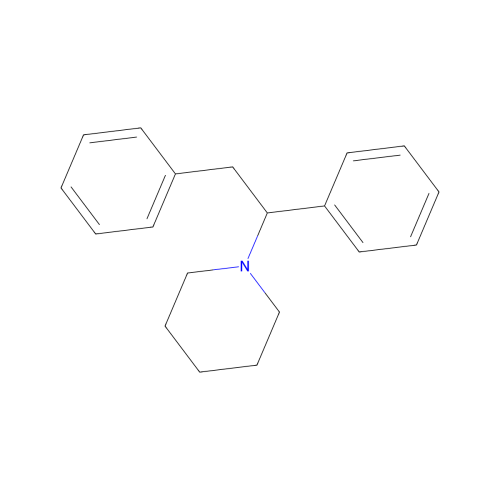
Diphenidine
Price range: $399.00 through $8,505.00Select options This product has multiple variants. The options may be chosen on the product page
Ephenidine
Price range: $399.00 through $8,505.00Select options This product has multiple variants. The options may be chosen on the product page