What is MDA?
MDA, or 3,4-methylenedioxyamphetamine, is a synthetic ring-substituted amphetamine with stimulant, empathogenic and psychedelic properties. It is also known by the informal names Sass, Sally and Love. MDA is closely related to MDMA, but it lacks the additional N-methyl group that distinguishes MDMA from its parent compound. MDA is also formed as a minor active metabolite when the body processes MDMA, although it can be taken as a substance in its own right.
History and chemical structure
MDA was first synthesized in 1910, before MDMA, and was later investigated for several possible medical uses, including as an appetite suppressant and a tranquillizing agent. It was never established as a widely used medicine. Its nonmedical use became more visible in the second half of the twentieth century, often under names that overlapped with those used for MDMA.
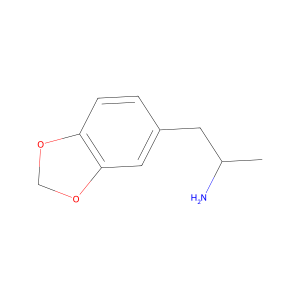
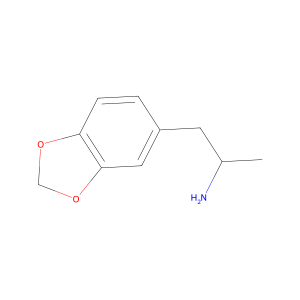
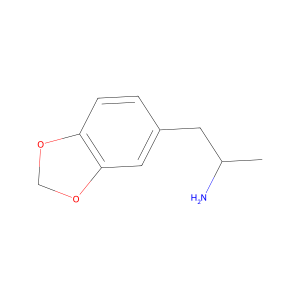
The molecule contains a methylenedioxy ring substituent at the 3- and 4-positions of the aromatic ring, together with the alpha-methyl group characteristic of amphetamines. The terminal nitrogen is primary, whereas MDMA carries an N-methyl substituent. This difference influences transporter interactions, metabolism and the balance between stimulant and psychedelic-like effects.
Pharmacology
MDA acts as a substrate at monoamine transporters and promotes the release of serotonin, noradrenaline and dopamine. Compared with MDMA, its pharmacological profile is somewhat more dopaminergic and it has stronger agonist activity at the 5-HT2A receptor. This helps explain why MDA is often described as having a more pronounced perceptual component than MDMA, while retaining empathogenic and stimulant effects.
Transporter-mediated release and direct receptor activation contribute differently to the effects. The release of monoamines contributes to stimulation, mood elevation and social-emotional effects, while 5-HT2A activity can contribute to visual and other psychedelic-like changes. Neither mechanism alone accounts for the complete experience.
Human pharmacology and reported effects
For many years, modern human research on MDA was sparse. A 2019 controlled study in healthy volunteers found that MDA produced both MDMA-like emotional effects and more pronounced psychedelic-like changes, with subjective effects lasting longer than those reported in the investigators’ earlier MDMA study. In a randomized, double-blind, placebo-controlled crossover trial published online in September 2025, Straumann and colleagues directly compared MDA and MDMA in the same 23 healthy adults. MDA produced stronger and longer-lasting subjective effects, greater stimulation, more visual alterations and higher ratings of fear and unpleasant effects than MDMA. The average duration of the main subjective effects was about six hours for MDA and four hours for MDMA in that study. The findings are reported in the 2025 controlled comparison of MDA and MDMA in healthy participants.
These results do not mean that every person experiences MDA as more psychedelic or more difficult than MDMA. The study used screened volunteers under controlled conditions, and its findings describe the tested formulation and setting. They do, however, provide direct evidence that the two closely related compounds are not interchangeable in their acute effects.
| Physical and perceptual effects | Cognitive and emotional effects |
|---|---|
|
|
Metabolism and toxicology
MDA is metabolized through O-demethylenation, hydroxylation and conjugation pathways. It is also produced from MDMA through N-demethylation, so the detection of MDA in a biological sample does not by itself prove that MDA was taken directly. The relative concentrations of parent compounds and metabolites, together with other markers, are needed for interpretation.
Acute toxicity can involve cardiovascular strain, hyperthermia, agitation and disturbances of fluid balance. A review of the role of MDA and MDMA metabolism in toxicity discusses reactive metabolites and their possible contribution to serotonergic neurotoxicity. Much of this evidence comes from experimental models, and translating it into long-term human outcomes is not straightforward. The risks are not limited to the parent molecule: reactive metabolites and environmental factors, including heat and prolonged exertion, can influence the severity of intoxication.
The 2025 human comparison found a less favourable acute tolerability profile for MDA than for MDMA under the conditions tested. It does not establish a universal risk ranking, but it reinforces the importance of treating the two substances as distinct compounds rather than assuming that their shared chemical family guarantees similar effects.
MDA Products
Scientific Data
Identity and Structure
| Chemical Name | 3,4-Methylenedioxyamphetamine (MDA) |
|---|---|
| Catalog Entity Type | Compound |
| Formula | C10H13NO2 |
| Molar Mass | 179.219 g·mol−1 |
| CAS | 4764-17-4 |
| CAS Numbers and Substance Forms | 4764-17-4 |
| Synonyms | MDA; Tenamfetamine; Amphedoxamine; Sally; Sassafras; Sass-a-frass; Sass; Mellow Drug of America; Hug drug; Love; 3,4-Methylenedioxy-α-methylphenethylamine; 5-(2-Aminopropyl)-1,3-benzodioxole; EA-1298; NSC-9978; NSC-27106; SKF-5 |
| IUPAC Name | 1-(2H-1,3-Benzodioxol-5-yl)propan-2-amine |
| InChI | InChI=1S/C10H13NO2/c1-7(11)4-8-2-3-9-10(5-8)13-6-12-9/h2-3,5,7H,4,6,11H2,1H3 |
| InChIKey | NGBBVGZWCFBOGO-UHFFFAOYSA-N |
| SMILES | NC(C)CC1=CC2=C(C=C1)OCO2 |
Chemical Identifiers
| PubChem CID | 1614 |
|---|---|
| ChemSpider ID | 1555 |
| DrugBank ID | DB01509 |
| ChEBI ID | CHEBI:166520 |
| KEGG ID | D12715 |
| UNII | XJZ28FJ27W |
| ChEMBL ID | ChEMBL6731 |
| CompTox DTXSID | DTXSID40859958 |
| ECHA ID | 100.230.706 |
Clinical Data
| Drug Class | Serotonin–norepinephrine–dopamine releasing agent; Serotonin 5-HT2 receptor agonist; Entactogen; Empathogen; Serotonergic psychedelic; Hallucinogen; Stimulant |
|---|---|
| Routes of Administration | Oral, sublingual, insufflation, intravenous |
| ATC Code | None |
Pharmacokinetics
| Metabolism | Hepatic (CYP extensively involved) |
|---|---|
| Onset of Action | 0.7 hours (range 0.3 to 1.1 hours) Peak: 2.0 hours (range 1.0–3.5 hours) |
| Elimination Half-life | 8.4–10.9 hours |
| Duration of Action | 5–8 hours (range 1–10 hours) |
| Excretion | Renal |
Legal Status
| Legal Status (Wikipedia Source Text) | AU: S9 (Prohibited substance) BR: Class F2 (Prohibited psychotropics) CA: Schedule I DE: Anlage I (Authorized scientific use only) UK: Class A US: Schedule I UN: Psychotropic Schedule I EU: Fully prohibited SE: Förteckning I |
|---|
Sources and Attribution
| Wikipedia Source URL | https://en.wikipedia.org/?curid=692929 |
|---|