What is 5-MeO-DiPT?
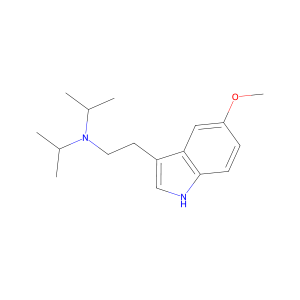
5-MeO-DiPT, also known as Foxy or Foxy Methoxy, is a synthetic psychedelic tryptamine. Its chemical name is 5-methoxy-N,N-diisopropyltryptamine. The molecule carries a methoxy group at the 5-position of the indole ring and two isopropyl groups on the terminal nitrogen. It is related to DMT and other 5-methoxy tryptamines, but its larger N-alkyl groups give it a distinct pharmacological and metabolic profile.
History and early reports
5-MeO-DiPT was described in the early literature on substituted tryptamines and later became known through Alexander Shulgin’s work and the online research-chemical market. It was sometimes sold under the name Foxy, and reports of its use emphasized both psychedelic effects and unusual physical sensations. The compound attracted particular attention in Japan in the early 2000s, where clinical intoxications and forensic detections were documented.
Receptor pharmacology
5-MeO-DiPT interacts with several serotonin receptors. Fantegrossi and colleagues examined its effects in mice and rats in a 2006 study. It produced the head-twitch response in mice, and this behaviour was strongly reduced by the selective 5-HT2A antagonist M100907. In rats trained to recognize LSD, 5-MeO-DiPT produced partial generalization to the LSD cue. The behavioural findings implicated 5-HT2A signalling, even though the compound showed higher affinity for 5-HT1A receptors than for 5-HT2A and 5-HT2C in the receptor measurements. The study is available as “Hallucinogen-like actions of 5-methoxy-N,N-diisopropyltryptamine in mice and rats”.
A 2023 receptor study by Kozell and colleagues also found strong functional activity for 5-MeO-DiPT at 5-HT2A, 5-HT2C and 5-HT1A receptors. As with other 5-methoxy tryptamines, activity at 5-HT1A may contribute to effects that are not captured by a simple 5-HT2A-only explanation. These measurements were part of their 2023 receptor study of substituted tryptamines.
Metabolism and toxicology
Human urinary metabolism has been studied directly. Investigators identified several major pathways, including O-demethylation to 5-OH-DiPT, aromatic hydroxylation and N-deisopropylation. The hydroxylated metabolites were found in urine, often as sulfate or glucuronide conjugates. The parent compound could still be detected in samples collected up to 35 hours after exposure. These findings are useful for forensic detection because they show that testing only for the unchanged parent substance may miss a substantial part of the metabolic picture. See the human urinary-metabolism study of 5-MeO-DiPT.
Clinical reports include two Japanese cases of transient psychiatric symptoms after ingestion. A separate forensic report described a fatal poisoning in which 5-MeO-DiPT and two metabolites were identified in blood and urine. The existence of that case is important, but a single report cannot define a general toxic concentration or establish a dose-response relationship. The circumstances and analytical findings are described in the 2006 fatal-poisoning report; the two transient psychiatric presentations were published in a 2005 clinical case report.
More recent animal research has also examined acute toxicity, locomotor activity and hallucinogen-like behaviour. A 2025 study found that 5-MeO-DiPT inhibited locomotor activity and induced the head-twitch response in mice, with the latter blocked by a 5-HT2A antagonist. These results reinforce the serotonergic activity seen in earlier work, but animal toxicity findings cannot be translated directly into human risk estimates. See the comparative mouse study of AMT, 5-MeO-AMT and 5-MeO-DiPT.
Subjective effects
Descriptions collected by PsychonautWiki and historical user reports describe a combination of stimulation, sensory changes and pronounced bodily effects. Some accounts emphasize tactile enhancement and changes in auditory perception, while others describe visual effects and altered thinking. The experience is not consistently described as similar to LSD or psilocybin; its physical and sensory character is often given more emphasis.
| Physical and perceptual effects | Cognitive and emotional effects |
|---|---|
|
|
Clinical reports add evidence of serious harm to the subjective descriptions. The case reports and fatal poisoning do not mean that every exposure produces severe toxicity, but they do show that the compound cannot be treated as a benign variant of other tryptamines.
5-MeO-DiPT Products
Scientific Data
Identity and Structure
| Chemical Name | 5-MeO-DiPT |
|---|---|
| Catalog Entity Type | Compound |
| Formula | C17H26N2O |
| Molar Mass | 274.408 g·mol−1 |
| CAS | 4021-34-5 |
| CAS Numbers and Substance Forms | 4021-34-5 |
| Synonyms | 5-OMe-DiPT; 5-Methoxy-N,N-diisopropyltryptamine; Foxy; Foxy Methoxy |
| IUPAC Name | N-[2-(5-methoxy-1H-indol-3-yl)ethyl]-N-propan-2-ylpropan-2-amine |
| InChI | InChI=1S/C17H26N2O/c1-12(2)19(13(3)4)9-8-14-11-18-17-7-6-15(20-5)10-16(14)17/h6-7,10-13,18H,8-9H2,1-5H3 |
| InChIKey | DNBPMBJFRRVTSJ-UHFFFAOYSA-N |
| SMILES | CC(C)N(C(C)C)CCC1=C[NH]C(C=C2)=C1C=C2OC |
Chemical Identifiers
| PubChem CID | 151182 |
|---|---|
| ChemSpider ID | 133247 |
| DrugBank ID | DB01441 |
| ChEBI ID | CHEBI:48282 |
| KEGG ID | C22724 |
| UNII | 12D06G8W8E |
| CompTox DTXSID | DTXSID00193209 |
Physical Properties
| Melting Point | 181 °C (358 °F) |
|---|
Clinical Data
| Drug Class | Non-selective serotonin receptor agonist; Serotonin 5-HT2A receptor agonist; Serotonergic psychedelic; Hallucinogen; Entactogen; Stimulant |
|---|---|
| Routes of Administration | Oral, others |
Pharmacokinetics
| Onset of Action | 20–30 min or ≤1 hour |
|---|---|
| Duration of Action | 3–6 hours or 4–8 hours |
Legal Status
| Legal Status (Wikipedia Source Text) | BR: Class F2 (Prohibited psychotropics) CA: Unscheduled DE: Anlage I (Authorized scientific use only) UK: Class A US: Schedule I UN: Unscheduled In general Unscheduled and not approved for human consumption, Illegal in Sweden, Denmark, Greece, Japan, Singapore and China |
|---|
Sources and Attribution
| Wikipedia Source URL | https://en.wikipedia.org/?curid=785808 |
|---|