What is LSD (LSD-25)?
LSD, or lysergic acid diethylamide, is a potent synthetic psychedelic of the ergoline family. It is also known as LSD-25 or lysergide. The compound was first synthesized by Albert Hofmann in 1938 while he was investigating derivatives of lysergic acid, but its unusual psychoactive effects were not recognized until 1943. LSD has since become one of the most extensively studied classic psychedelics, with research spanning receptor pharmacology, human consciousness, psychiatric treatment and forensic toxicology.
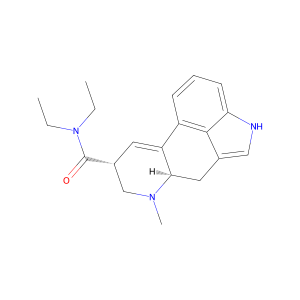
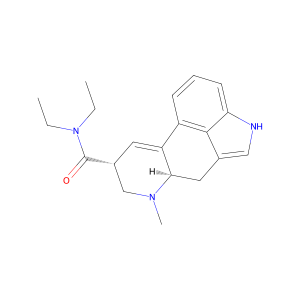
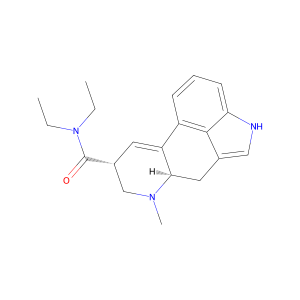
Its structure is built around the lysergic acid skeleton, a fused tetracyclic system known as an ergoline. The diethylamide group attached to the carboxyl position is essential to its characteristic activity: even relatively small changes to this part of the molecule can substantially alter potency. LSD is related to a wider family of lysergamides, including LSA, LSZ and AL-LAD, but these compounds are not pharmacologically interchangeable.
Discovery and early research
Hofmann synthesized LSD while working at Sandoz in Basel. Five years later, after accidental exposure and a deliberate self-experiment, he recognized that the compound could produce profound changes in perception and thought at very small quantities. Sandoz subsequently distributed LSD to researchers and clinicians under the name Delysid, and it was investigated in experimental psychiatry, psychotherapy and studies of consciousness.
Clinical interest declined after nonmedical use became widespread and legal restrictions expanded. Research resumed more systematically in the late twentieth and early twenty-first centuries, with modern studies examining controlled administration, pharmacokinetics and possible therapeutic applications. The newer literature is more rigorous than many of the early reports, although sample sizes remain relatively small in several areas.
Receptor pharmacology
LSD interacts with several serotonin receptors, particularly 5-HT2A, whose activation is central to the perceptual and cognitive effects of classic psychedelics. It acts as a partial agonist at 5-HT2A receptors, but its signalling is not limited to this target. LSD also interacts with 5-HT1A, 5-HT2C and several other serotonin receptor subtypes, as well as dopaminergic receptors. The relative importance of these interactions changes with concentration and experimental system.
The duration of LSD’s effects is unusually long for a small-molecule psychedelic. Receptor residence time has been proposed as one contributor: structural studies have shown that LSD can remain bound within the 5-HT2A receptor binding pocket for an extended period. This is not the only factor involved, since absorption, distribution and metabolism also shape the time course.
Pharmacokinetics and metabolism
After oral administration, LSD is absorbed relatively quickly and reaches peak plasma concentrations within roughly one to two hours in many controlled studies. Its elimination half-life is usually reported in the range of several hours, while subjective effects commonly last considerably longer. A 2026 systematic review of pharmacokinetic studies in healthy adults found variation between trials in peak concentration, time to peak and half-life, reflecting differences in study design, dose and sampling schedules. The review also noted that the available human datasets remain modest in size.
LSD is metabolized in the liver through several pathways. One of the most useful metabolites for forensic analysis is 2-oxo-3-hydroxy-LSD (O-H-LSD), which can remain detectable after the parent compound has fallen below analytical limits. Other metabolites include nor-LSD and hydroxylated derivatives. The metabolic pathways and their relevance to clinical and forensic testing are reviewed in “Metabolism of lysergic acid diethylamide (LSD): an update”.
The clinical research literature has expanded beyond pharmacokinetics. Studies have examined LSD-assisted psychotherapy, anxiety associated with life-threatening illness and alcohol use disorder. Results from small controlled trials have been encouraging in some settings, but they do not establish broad clinical effectiveness or long-term safety. A 2025 review of LSD research discusses these findings alongside cardiovascular effects, psychological vulnerability and the possibility of hallucinogen-persisting perception disorder. See the 2025 review of LSD research in psychiatry and neuroscience.
Subjective effects
The subjective effects of LSD are highly variable. They depend on the individual, the setting, expectations and the intensity of the experience. Changes in visual processing are common, but the experience can also involve altered time perception, emotional amplification, unusual associations in thought and changes in the ordinary sense of self. Some people describe a sense of insight or connectedness; others experience anxiety, confusion or fear.
| Perceptual and physical effects | Cognitive and emotional effects |
|---|---|
|
|
Auditory changes are also reported, particularly increased attention to music and altered perceptions of tone or texture. Synesthetic experiences, in which one sensory quality seems to take on the character of another, occur in some accounts but are not universal.
Acute toxicity and longer-term concerns
LSD does not usually produce the same pattern of direct organ toxicity associated with many stimulant drugs, but this should not be confused with an absence of risk. Acute effects can include increased heart rate and blood pressure, anxiety, panic, disorientation and impaired judgment. Severe psychological reactions may require medical attention, especially when a person becomes unable to distinguish internal perceptions from external events.
Accidents and dangerous behaviour can occur when perception and judgment are substantially altered. A small number of people report persistent visual disturbances after the acute effects have ended, a condition described as hallucinogen-persisting perception disorder (HPPD). Its frequency and mechanisms remain uncertain. The much more common, short-lived visual effects during intoxication do not establish the risk of persistent symptoms.
Controlled clinical studies generally use screened participants, known material and medical supervision. Their short-term safety findings cannot be generalized to unknown products, unsupervised use or combinations with other substances. LSD’s pharmacology is well studied compared with that of many novel psychedelics, but individual responses and longer-term outcomes are not fully predictable.
LSD (LSD-25) Products
Scientific Data
Identity and Structure
| Chemical Name | LSD |
|---|---|
| Catalog Entity Type | Compound |
| Formula | C20H25N3O |
| Molar Mass | 323.440 g·mol−1 |
| CAS | 50-37-3 |
| CAS Numbers and Substance Forms | 50-37-3 |
| Synonyms | LSD; LSD-25; LAD; Acid; Lucy; Lysergide; d-LSD; (+)-LSD; (5R,8R)-LSD; 9,10-Didehydro-N,N-diethyl-6-methylergoline-8β-carboxamide; N,N-Diethyl-d-lysergamide; d-Lysergic acid diethylamide; METH-LAD; EA-1729; MM120; MM-120; DT120; DT-120 |
| IUPAC Name | (6aR,9R)-N,N-diethyl-7-methyl-4,6,6a,7,8,9-hexahydroindolo[4,3-fg]quinoline-9-carboxamide |
| InChI | InChI=1S/C20H25N3O/c1-4-23(5-2)20(24)14-9-16-15-7-6-8-17-19(15)13(11-21-17)10-18(16)22(3)12-14/h6-9,11,14,18,21H,4-5,10,12H2,1-3H3/t14-,18-/m1/s1 |
| InChIKey | VAYOSLLFUXYJDT-RDTXWAMCSA-N |
| SMILES | CCN(CC)C(=O)[C@H]1CN([C@@H]2CC3=CNC4=CC=CC(=C34)C2=C1)C |
Chemical Identifiers
| PubChem CID | 5761 |
|---|---|
| ChemSpider ID | 5558 |
| DrugBank ID | DB04829 |
| ChEBI ID | CHEBI:6605 |
| KEGG ID | C07542 |
| UNII | 8NA5SWF92O |
| ChEMBL ID | ChEMBL263881 |
| IUPHAR/BPS ID | 17 |
| CompTox DTXSID | DTXSID1023231 |
| ECHA ID | 100.000.031 |
| PDB Ligand | 7LD (PDBe, RCSB PDB) |
Physical Properties
| Melting Point | 80 to 85 °C (176 to 185 °F) |
|---|---|
| Solubility | 67.02 mg/mL (20 °C) |
Clinical Data
| Drug Class | Serotonin receptor agonist; Serotonin 5-HT2A receptor agonist; Serotonergic psychedelic; Hallucinogen |
|---|---|
| Trade Names | Delysid |
| Pronunciation | /daɪ eθəl ˈæmaɪd/, /æmɪd/, or /eɪmaɪd/ |
| Routes of Administration | Oral |
| ATC Code | None |
| Dependence Liability | None |
| Addiction Liability | None |
| Pregnancy Category (Source Text) | C |
| AHFS / Drugs.com | Reference |
Pharmacokinetics
| Bioavailability | 80% |
|---|---|
| Protein Binding | Unknown (but 65–90% in guinea pigs) |
| Metabolism | Liver (CYP450) |
| Metabolites | • 2-Oxo-3-hydroxy-LSD • 2-Oxo-LSD • LAETooltip Lysergic acid ethylamide • LEOTooltip Lysergic acid ethyl-2-hydroxyethylamide • Nor-LSD • 13-Hydroxy-LSD • 14-Hydroxy-LSD • Glucuronides |
| Onset of Action | Oral: 0.4–1.0 (range 0.1–1.8) hours IMTooltip Intramuscular injection: 15–20 min IVTooltip Intravenous injection: 2.5 min ITTooltip Intrathecal injection: <1 min |
| Elimination Half-life | 3.0–4.3 hours |
| Duration of Action | Oral: 7–12 (range 4–22) hours IMTooltip Intramuscular injection, IVTooltip Intravenous injection, ITTooltip Intrathecal injection: 8–10 hours |
| Excretion | Kidneys |
Legal Status
| Legal Status (Wikipedia Source Text) | AU: S9 (Prohibited substance) BR: Class F2 (Prohibited psychotropics) CA: Schedule III DE: Anlage I (Authorized scientific use only) NZ: Class A UK: Class A US: Schedule I UN: Psychotropic Schedule I SE: Förteckning I Illicit drug |
|---|
Sources and Attribution
| Wikipedia Source URL | https://en.wikipedia.org/?curid=17537 |
|---|