What is AL-LAD?
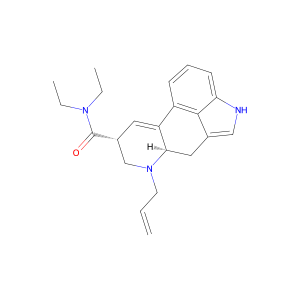
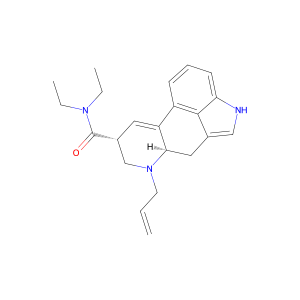
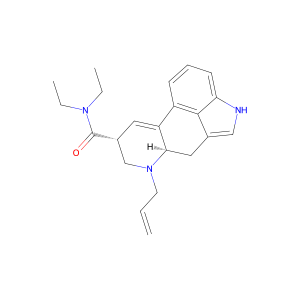
AL-LAD, also known as Aladdin or 6-allyl-6-nor-LSD, is a synthetic psychedelic in the lysergamide family. Its full chemical name is N6-allyl-6-norlysergic acid diethylamide. It is closely related to LSD, but the methyl group attached to the N6 position of LSD is replaced by an allyl group. This relatively small structural change produces a distinct compound, with its own analytical profile and a somewhat different pattern of effects in animal studies and user reports.
Chemistry and analytical identification
AL-LAD retains the ergoline skeleton and diethylamide group of LSD. The principal difference lies at the N6 position, where the allyl substituent replaces LSD’s methyl group. The modification is part of a wider series of N6-substituted lysergamides, including ETH-LAD and PRO-LAD. Work on this series has shown that the size and shape of the N6 substituent can influence pharmacological activity; a shared core structure does not make these compounds pharmacologically interchangeable.
AL-LAD appeared on the new psychoactive substance market in powder and blotter form around 2013. Brandt and colleagues subsequently characterized powdered AL-LAD tartrate and material on blotter paper using NMR, gas chromatography–mass spectrometry, high-resolution electrospray MS/MS, HPLC with diode-array detection and GC solid-state infrared analysis. Their study also examined the compound in mice using the head-twitch response, a behavioural marker associated with 5-HT2A receptor activation. AL-LAD produced a dose-dependent response, with an estimated ED50 of 174.9 nmol/kg, compared with 132.8 nmol/kg for LSD in the same model. The difference was modest in mice; it should not be read as a direct estimate of relative human potency. The full analytical and behavioural work is reported in Brandt et al.’s study of AL-LAD and LSZ.
Pharmacology
Like LSD, AL-LAD produces hallucinogen-like activity in the mouse head-twitch response. Earlier drug-discrimination experiments also found that AL-LAD substituted for LSD in rats trained to recognize the latter compound. Receptor-binding studies reported high affinity for 5-HT2A receptors, which are central to the effects of classic serotonergic psychedelics.
The relationship between receptor affinity and the experience in humans is not a simple one-to-one calculation. Binding assays measure how strongly a compound interacts with a receptor, while behavioural tests capture a particular response in an animal model. Neither measurement by itself determines the quality, duration or intensity of a human experience.
Subjective effects
Human descriptions of AL-LAD are available mainly through historical self-experiments and online reports. A large anonymous survey of people who use drugs included AL-LAD alongside 1P-LSD and ETH-LAD. Respondents generally described the group as psychedelic, with a modal duration of around eight hours and a peak near two hours. The study did not chemically verify the substances or separate every reported effect by individual analogue, so its results are best understood as a broad picture of lysergamide-analogue use rather than a precise AL-LAD profile. The survey was published as “Genie in a blotter: A comparative study of LSD and LSD analogues’ effects and user profile”.
Accounts collected in PsychonautWiki’s AL-LAD entry often emphasize visual effects and a relatively clear or less mentally demanding experience than LSD. Reports describe changes in colour, geometric patterns, drifting surfaces and altered depth perception. Some users also mention stimulation, increased appreciation of music and a more playful emotional tone. Others report nausea, tension or anxiety, particularly when the experience becomes overwhelming. These descriptions are not clinical observations and cannot establish that AL-LAD reliably produces a lighter or more manageable experience than LSD.
| Physical and visual effects | Cognitive and emotional effects |
|---|---|
|
|
Human evidence and remaining questions
AL-LAD has a useful analytical and preclinical research record, but its human pharmacology has not been investigated to the same standard as LSD. The available survey relied on self-selected respondents and unverified substance identities. Controlled human studies would be needed to establish its pharmacokinetics, dose–response relationship and the extent to which its subjective effects differ from those of LSD.
AL-LAD Products
Scientific Data
Identity and Structure
| Chemical Name | AL-LAD |
|---|---|
| Catalog Entity Type | Compound |
| Formula | C22H27N3O |
| Molar Mass | 349.478 g·mol−1 |
| CAS | 65527-61-9 |
| CAS Numbers and Substance Forms | 65527-61-9 |
| Synonyms | ALLAD; AllylLAD; Allyl-LAD; ALLYLAD; AllyLAD; ALLY-LAD; 6-Allyl-6-nor-LSD; 6-Allyl-6-nor-N,N-diethyllysergamide; 9,10-Didehydro-6-allyl-N,N-diethylergoline-8β-carboxamide |
| IUPAC Name | (6aR,9R)-N,N-diethyl-7-prop-2-enyl-6,6a,8,9-tetrahydro-4H-indolo[4,3-fg]quinoline-9-carboxamide |
| InChI | InChI=1S/C22H27N3O/c1-4-10-25-14-16(22(26)24(5-2)6-3)11-18-17-8-7-9-19-21(17)15(13-23-19)12-20(18)25/h4,7-9,11,13,16,20,23H,1,5-6,10,12,14H2,2-3H3/t16-,20-/m1/s1 |
| InChIKey | JCQLEPDZFXGHHQ-OXQOHEQNSA-N |
| SMILES | [H][C@@]12Cc3c[nH]c4cccc(C1=C[C@@H](C(=O)N(CC)CC)CN2CC=C)c34 |
Chemical Identifiers
| PubChem CID | 15227511 |
|---|---|
| ChemSpider ID | 21106248 |
| UNII | 020O2SR91L |
| ChEMBL ID | ChEMBL281787 |
| CompTox DTXSID | DTXSID30215822 |
Clinical Data
| Drug Class | Non-selective serotonin receptor agonist; Serotonin 5-HT2A receptor agonist; Serotonergic psychedelic; Hallucinogen |
|---|---|
| Routes of Administration | Oral |
| ATC Code | None |
Pharmacokinetics
| Onset of Action | 15–20 minutes or hours |
|---|---|
| Duration of Action | 6–8 hours |
Legal Status
| Legal Status (Wikipedia Source Text) | AU: Unscheduled CA: Unscheduled. DE: NpSG (Industrial and scientific use only) UK: Class A US: Unscheduled, could be illegal if is sold for human consumption under the Federal Analogue Act. Illegal in Denmark, Sweden, Switzerland and France, could be illegal in many countries if is sold for human consumption or under the several analogue acts |
|---|
Sources and Attribution
| Wikipedia Source URL | https://en.wikipedia.org/?curid=5836932 |
|---|