What is PRO-LAD?
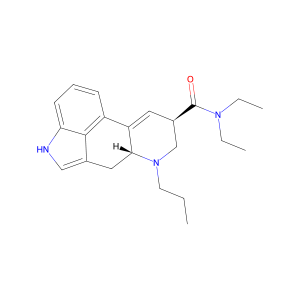
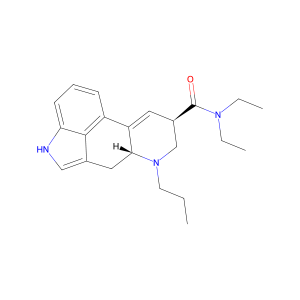
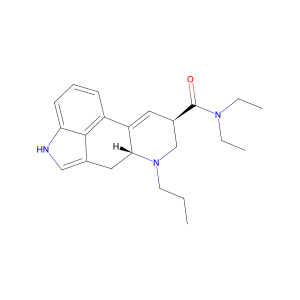
PRO-LAD, also written as PROLAD, 6-propyl-6-nor-LSD or 6-propylnorlysergic acid diethylamide, is a synthetic psychedelic lysergamide related to LSD. It carries a straight-chain propyl group at the N6 position of the ergoline structure, replacing the methyl group found in LSD. It is closely related to AL-LAD and ETH-LAD, which carry allyl and ethyl groups at the same position.
Discovery and chemical characterization
PRO-LAD was synthesized as part of the N6-substituted lysergamide series developed by Andrew Hoffman and David Nichols at Purdue University. The series was designed to examine how changes at the N6 position affected LSD-like activity. The compounds were prepared and tested in a rat drug-discrimination model, providing an early structure–activity comparison across several N-alkyl substituents.
The propyl group distinguishes PRO-LAD from PARGY-LAD. Both contain three carbon atoms in the substituent, but PARGY-LAD has a propargyl group with a carbon–carbon triple bond. The 1985 research showed that this apparently small structural difference was associated with a substantial difference in behavioural potency.
Pharmacological activity
In the rat drug-discrimination assay, PRO-LAD fully substituted for LSD. Hoffman and Nichols reported that the N6-propyl derivative was approximately equipotent to LSD in this model. The same study found that the N6-isopropyl analogue was about half as active, while the propargyl and butyl derivatives were substantially less potent. These results show that the length and geometry of the N6 substituent can have a pronounced effect on lysergamide activity.
The study measured behavioural substitution and receptor binding in rat brain tissue; it was not a human clinical trial. Equipotency in a rat discrimination assay should therefore not be interpreted as proof that PRO-LAD and LSD have the same potency in people. The original results are reported in Hoffman and Nichols’ 1985 study of N6-alkyl norlysergic acid diethylamides.
Subjective effects
The human descriptions of PRO-LAD come mainly from Alexander Shulgin’s observations in TiHKAL and later user reports. Shulgin’s account is notable because the experience changed considerably between the observations he recorded. At the lower end, he described little more than a subtle alteration and questioned whether the effect was psychedelic. In a later experience, visual effects became more apparent, while the mental state remained relatively clear and humour was prominent.
Shulgin also described a period of unease and difficulty communicating during one experience, followed by a more comfortable phase in which music, food and emotional responses became more engaging. His later comments characterized PRO-LAD as intellectually clear and unusually good for humour, without the strongly cosmic or expansive quality he associated with some other psychedelics. These are individual observations, not a controlled assessment of the compound.
| Physical and visual effects | Cognitive and emotional effects |
|---|---|
|
|
Shulgin’s account gives PRO-LAD a more specific human description than many research lysergamides have, but it remains a small set of uncontrolled observations. It cannot establish how often the more comfortable or more difficult features occur, or whether they reflect the compound itself, the context or individual variation. The original account is available in TiHKAL, entry #51: PRO-LAD.
Pharmacokinetics and toxicology
No controlled human pharmacokinetic study has established PRO-LAD’s absorption, peak concentration, elimination half-life or metabolic pathways. Durations reported in historical and user accounts are not measured pharmacokinetic parameters. Likewise, the animal drug-discrimination data do not establish a safe or toxic exposure range in humans.
PRO-LAD is therefore better characterized than many recently marketed lysergamides in terms of its synthesis and animal behavioural activity, but its human evidence remains narrow. The available observations support an LSD-related psychedelic profile with reports of relative mental clarity and humour, while leaving its clinical pharmacology and toxicological risks insufficiently defined.
PRO-LAD Products
Scientific Data
Identity and Structure
| Chemical Name | PRO-LAD |
|---|---|
| Catalog Entity Type | Compound |
| Formula | C22H29N3O |
| Molar Mass | 351.494 g·mol−1 |
| CAS | 65527-63-1 |
| CAS Numbers and Substance Forms | 65527-63-1 |
| Synonyms | PROLAD; 6-Propyl-6-nor-LSD; 6-Propyl-nor-LSD; 6-Propyl-6-norlysergic acid diethylamide; N,N-Diethyl-6-propyl-9,10-didehydroergoline-8β-carboxamide |
| IUPAC Name | (6aR,9R)-N,N-diethyl-7-propyl-6,6a,8,9-tetrahydro-4H-indolo[4,3-fg]quinoline-9-carboxamide |
| InChI | InChI=1S/C22H29N3O/c1-4-10-25-14-16(22(26)24(5-2)6-3)11-18-17-8-7-9-19-21(17)15(13-23-19)12-20(18)25/h7-9,11,13,16,20,23H,4-6,10,12,14H2,1-3H3/t16-,20-/m1/s1 |
| InChIKey | HZKYLVLOBYNKKM-OXQOHEQNSA-N |
| SMILES | CCN(CC)C(=O)[C@@H]2C=C1c3cccc4[nH]cc(C[C@H]1N(C2)CCC)c34 |
Chemical Identifiers
| PubChem CID | 44457803 |
|---|---|
| ChemSpider ID | 21106361 |
| UNII | RVR83W9XMC |
| ChEMBL ID | ChEMBL22258 |
| CompTox DTXSID | DTXSID50215824 |
Clinical Data
| Drug Class | Serotonin receptor modulator; Serotonin 5-HT2A receptor agonist; Serotonergic psychedelic; Hallucinogen |
|---|---|
| Routes of Administration | Oral |
Pharmacokinetics
| Onset of Action | ≤15 minutes |
|---|---|
| Duration of Action | 6–8 hours |
Legal Status
| Legal Status (Wikipedia Source Text) | DE: NpSG (Industrial and scientific use only) UK: Under Psychoactive Substances Act US: Analogue to a Schedule I/II drug but only if it is intended for human consumption Illegal in France |
|---|
Sources and Attribution
| Wikipedia Source URL | https://en.wikipedia.org/?curid=5837112 |
|---|