What is LSZ?
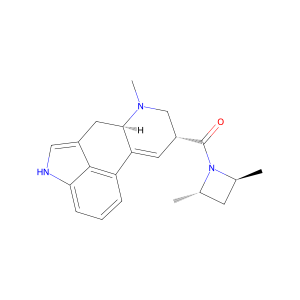
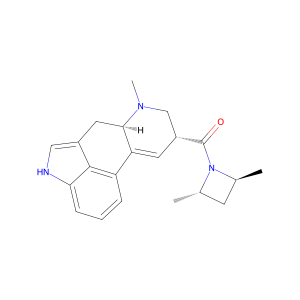
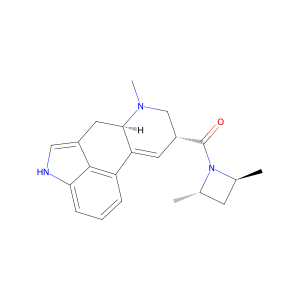
LSZ, also known as lysergic acid 2,4-dimethylazetidide or LA-SS-Az, is a synthetic psychedelic lysergamide related to LSD. Its amide group is incorporated into a 2,4-dimethylazetidine ring, rather than the diethylamide group found in LSD. The compound was first encountered on the new psychoactive substance market around 2013, usually in blotter or powder form.
Chemistry and analytical identification
The name LSZ refers to the two methyl substituents on the azetidine ring. The configuration of these groups matters: the material most often characterized in forensic studies is the (2′S,4′S) stereoisomer. Other stereoisomers are chemically possible, but should not be assumed to have the same pharmacological properties.
In their analytical and behavioural study of LSZ, Brandt and colleagues examined powdered LSZ tartrate and blotter material using nuclear magnetic resonance spectroscopy, gas chromatography–mass spectrometry, high-resolution electrospray mass spectrometry, HPLC with diode-array detection and GC solid-state infrared analysis. The work established a detailed reference profile for forensic identification and included a mouse head-twitch response experiment to assess hallucinogen-like activity. The same investigation also provided the mouse behavioural data discussed below.
Pharmacology
LSZ produced a dose-dependent head-twitch response in mice, a behavioural model associated with 5-HT2A receptor activation. Its estimated ED50 was 114.2 nmol/kg, compared with 132.8 nmol/kg for LSD in the reference experiment. On that measure, LSZ was approximately equipotent to LSD in mice. The researchers also found that the maximum response was lower than that produced by AL-LAD, illustrating that potency and maximum behavioural effect are not the same property.
These findings support LSD-like activity in the animal model, but they do not establish that LSZ is equally potent in humans. Head-twitch response is a useful preclinical assay, not a direct measurement of subjective intensity. The study’s authors explicitly cautioned against translating the numerical comparison directly to people.
Subjective effects
Human descriptions of LSZ come mainly from online reports. Accounts collected by PsychonautWiki generally compare it with LSD, describing visual geometry, changes in colour and depth perception, stimulation and altered thought. Some reports describe a more stimulating or physically uncomfortable experience, while others emphasize a relatively clear mental state. These descriptions are inconsistent and have not been tested in a controlled human study.
| Physical and visual effects | Cognitive and emotional effects |
|---|---|
|
|
The reported similarity to LSD fits the mouse behavioural findings, although the two substances may differ in their subjective effects. The available human reports are self-selected and do not provide reliable information about pharmacokinetics, duration or the frequency of adverse effects.
Forensic and clinical evidence
LSZ has been analytically confirmed in blotter material, but there is little published clinical information beyond its chemical characterization and preclinical activity. The available literature does not define its metabolism in humans or establish a dose–response relationship. As with other lysergamides, the presence of a familiar blotter design or a product label cannot confirm the identity or purity of the material.
LSZ Products
Scientific Data
Identity and Structure
| Chemical Name | LSZ |
|---|---|
| Catalog Entity Type | Compound |
| Formula | C21H25N3O |
| Molar Mass | 335.451 g·mol−1 |
| CAS | 470666-31-0 470666-32-1 |
| CAS Numbers and Substance Forms | freebase: 470666-31-0 tartrate salt: 470666-32-1 |
| Synonyms | Lysergic acid 2,4-dimethylazetidine; Lysergic acid 2S,4S-dimethylazetidine; LSZ; LA-Azetidide; LSD-Azetidide; LA-SS-Az; SS-LSZ; (S,S)-LSZ; Diazedine; λ; Lambda |
| IUPAC Name | [(6aR,9R)-7-methyl-6,6a,8,9-tetrahydro-4H-indolo[4,3-fg]quinoline-9-yl]-[(2S,4S)-2,4-dimethylazetidin-1-yl]methanone |
| InChI | InChI=1S/C21H25N3O/c1-12-7-13(2)24(12)21(25)15-8-17-16-5-4-6-18-20(16)14(10-22-18)9-19(17)23(3)11-15/h4-6,8,10,12-13,15,19,22H,7,9,11H2,1-3H3/t12-,13-,15+,19+/m0/s1 |
| InChIKey | DUKNIHFTDAXJON-CTQRGLTFSA-N |
| SMILES | freebase: C[C@H]1C[C@@H](N1C(=O)[C@H]2CN([C@@H]3CC4=CNC5=CC=CC(=C45)C3=C2)C)C |
Chemical Identifiers
| PubChem CID | 71301249 |
|---|---|
| ChemSpider ID | 30773535 |
| DrugBank ID | DB15196 |
| UNII | 8SWJ525W4R |
| CompTox DTXSID | DTXSID201026958 |
Clinical Data
| Drug Class | Non-selective serotonin receptor agonist; Serotonin 5-HT2A receptor agonist; Serotonergic psychedelic; Hallucinogen |
|---|---|
| Routes of Administration | Oral |
Pharmacokinetics
| Duration of Action | 3–11 hours (median 8 hours) |
|---|
Legal Status
| Legal Status (Wikipedia Source Text) | DE: NpSG (Industrial and scientific use only) UK: Class A Illegal in Denmark, France, Sweden, and Switzerland |
|---|
Sources and Attribution
| Wikipedia Source URL | https://en.wikipedia.org/?curid=19909799 |
|---|