What is DiPT?
DiPT, or N,N-diisopropyltryptamine, is a synthetic psychedelic tryptamine best known for its unusual effects on hearing. Its distinctive auditory profile is also summarized in PsychonautWiki’s DiPT entry. It is structurally related to DMT, but the two methyl groups on DMT’s terminal nitrogen are replaced by isopropyl groups. Unlike most classic psychedelics, whose reported perceptual effects are dominated by visual changes, DiPT is associated with marked auditory distortions, particularly changes in pitch and tone.
History and distinctive auditory effects
DiPT was described by Alexander Shulgin and Michael Carter in a 1980 paper that compared it with 5-MeO-DiPT. Their observations drew attention to its unusual auditory effects: sounds could appear lower in pitch, and musical intervals or familiar tones could seem altered. Later descriptions in TiHKAL developed this theme, making DiPT one of the best-known examples of a psychedelic whose reported sensory profile is not primarily visual.
The original paper, “N,N-Diisopropyltryptamine and 5-methoxy-N,N-diisopropyltryptamine: Two orally active tryptamine analogs with CNS activity”, remains an important source for the early human observations. These reports are not controlled psychophysical experiments, so the exact nature and frequency of the auditory effects are not firmly established.
Pharmacology
DiPT interacts with serotonin receptors. A 2016 receptor-interaction study found that it acts at 5-HT2A and 5-HT1A receptors, while also interacting with the serotonin transporter. A later animal study examined its discriminative stimulus effects and found that DiPT produced a drug cue that could be distinguished from the cue produced by DMT. This suggests that DiPT’s pharmacological differences from DMT extend beyond the relative prominence of visual effects.
In mice, DiPT’s behavioural effects were attenuated by a 5-HT2A antagonist, supporting a role for this receptor in its hallucinogen-like activity. The animal findings do not explain why the human reports emphasize auditory distortion, but they show that DiPT engages the same broad serotonergic pathway involved in many classic psychedelics. The discriminative-stimulus work is described in “Discriminative Stimulus Effects of N,N-Diisopropyltryptamine”.
Subjective effects
Human descriptions of DiPT consistently give unusual auditory perception a central role. Users have reported that tones sound lower, familiar music seems out of tune, and speech or environmental sounds can acquire an altered pitch. At stronger levels of intoxication, some accounts describe more complex auditory distortions. Visual changes may occur, but they are generally less emphasized than the changes in hearing.
| Auditory and physical effects | Cognitive and visual effects |
|---|---|
|
|
These descriptions are based on a small body of historical observations and user reports. There are no modern controlled human studies that quantify the pitch distortions or establish how they relate to receptor activity.
Research limitations
DiPT is pharmacologically interesting because its reported auditory effects differ from the more familiar visual profile of many serotonergic psychedelics. Its receptor activity and some animal behavioural properties have been studied, but the mechanism behind the distinctive auditory effects remains unresolved. Human pharmacokinetics, dose-response relationships and long-term safety are also poorly characterized.
DiPT Products
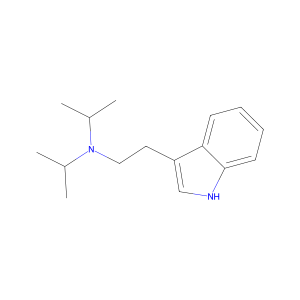
Scientific Data
Identity and Structure
| Chemical Name | DiPT |
|---|---|
| Catalog Entity Type | Compound |
| Formula | C16H24N2 |
| Molar Mass | 244.382 g·mol−1 |
| CAS | 14780-24-6 |
| CAS Numbers and Substance Forms | 14780-24-6 |
| Synonyms | Diisopropyltryptamine; N,N-Diisopropyltryptamine; DiPT; DIPT; Dipt; Dipsy |
| IUPAC Name | N-[2-(1H-indol-3-yl)ethyl]-N-propan-2-ylpropan-2-amine |
| InChI | InChI=1S/C16H24N2/c1-12(2)18(13(3)4)10-9-14-11-17-16-8-6-5-7-15(14)16/h5-8,11-13,17H,9-10H2,1-4H3 |
| InChIKey | ZRVAAGAZUWXRIP-UHFFFAOYSA-N |
| SMILES | CC(C)N(CCC1=CNC2=CC=CC=C21)C(C)C |
Chemical Identifiers
| PubChem CID | 26903 |
|---|---|
| ChemSpider ID | 25060 |
| ChEBI ID | CHEBI:48286 |
| UNII | E352B01VMH |
| CompTox DTXSID | DTXSID80163804 |
Clinical Data
| Drug Class | Serotonin receptor agonist; Serotonin 5-HT2A receptor agonist; Serotonergic psychedelic; Hallucinogen |
|---|---|
| Pronunciation | /ˌdaɪˌaɪsoʊˌproʊpɪlˈtrɪptəmiːn/ |
| Routes of Administration | Oral, smoking |
| ATC Code | None |
Pharmacokinetics
| Onset of Action | Oral: 20 minutes–1 hour Smoking: 4–8 minutes |
|---|---|
| Duration of Action | 4–8 hours |
Legal Status
| Legal Status (Wikipedia Source Text) | AU: Unscheduled CA: Unscheduled DE: NpSG (Industrial and scientific use only) UK: Class A US: Unscheduled UN: Unscheduled |
|---|
Sources and Attribution
| Wikipedia Source URL | https://en.wikipedia.org/?curid=1028627 |
|---|