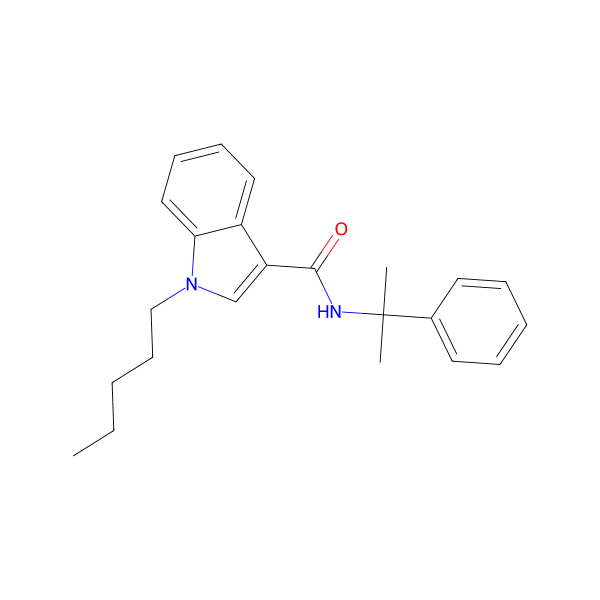
What is CUMYL-BICA?
CUMYL-BICA is a synthetic cannabinoid in the indole-3-carboxamide family. Its full structure includes a four-carbon butyl chain and a cumyl group, which contains a phenyl ring and two methyl groups attached through the same central carbon. CUMYL-PICA is a distinct compound with a five-carbon pentyl chain in the same position. The difference is small enough to miss in a short name and clear enough to matter when attributing an experimental result. UNODC chemical identity record.
Chemistry and identification
The indole gives the molecule its fused ring system. Its nitrogen carries the butyl chain, while a carboxamide at position 3 attaches the cumyl group. This puts CUMYL-BICA in the same broad structural branch as APICA, listed among the indolecarboxamides in the PsychonautWiki overview. APICA has an adamantane cage in place of the cumyl group. A closer comparison, CUMYL-CBMICA, preserves the cumyl group and replaces the straight chain with a side chain containing a four-membered ring.
Pharmacology
Two laboratory studies found that CUMYL-BICA activates both CB1 and CB2, but they ranked the receptors differently. In Banister and colleagues’ membrane-potential experiment, the compound needed a lower concentration to produce a half-maximal response at CB1. The same study tested CUMYL-PICA and several other cumyl analogues, allowing comparisons under a shared protocol. Comparative membrane-potential study.
An independent experiment reported half-maximal concentrations of approximately 1.21 nM at CB1 and 0.248 nM at CB2, giving the opposite order. These are functional measurements rather than estimates of how strongly the molecule binds at equilibrium. The response depends on how each experimental system expresses the receptor and records its activity. The two studies establish activity at both receptors, with the measured preference depending on the assay. Independent comparison of cumyl carboxamides.
Physical and subjective effects
The animal work in Banister’s study measured falling body temperature and a slower heart rate after CUMYL-PICA or CUMYL-5F-PICA. The rats received those two analogues. CUMYL-BICA’s contribution to the study was the cell-based receptor result. The similar names make it easy to attribute a physiological result to the wrong compound.
PsychonautWiki describes cannabis-like subjective effects across the broader class. For CUMYL-BICA, the measured receptor activity supplies a plausible basis for cannabinoid effects, but the sources reviewed do not establish a compound-specific pattern of sedation, changes in perception, anxiety or cardiovascular symptoms. The difference between the two receptor assays also gives no direct information about onset or duration in people.
Reviews
There are no reviews yet.