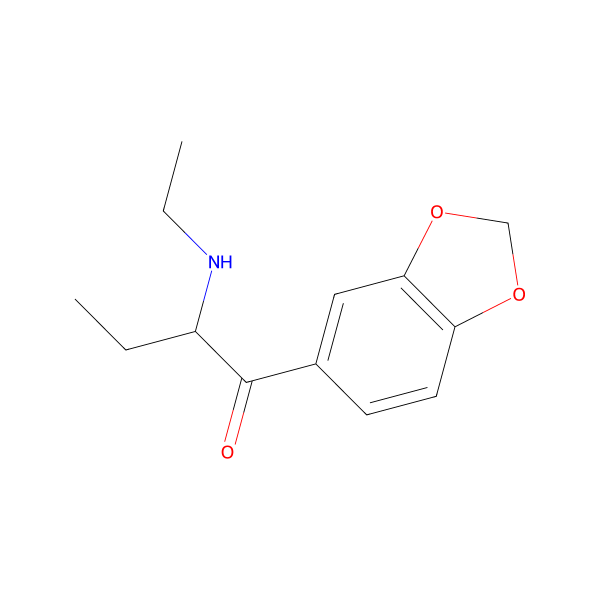
What is Eutylone?
Eutylone, also known as bk-EBDB or β-keto-ethylbenzodioxolylbutanamine, is a synthetic cathinone in the methylenedioxy-substituted group. It is structurally related to butylone, methylone and ethylone. Compared with ethylone, eutylone has an additional carbon in the α-side chain; compared with butylone, it carries an ethyl rather than a methyl substituent on the amino nitrogen. These differences distinguish compounds that are sometimes confused in forensic samples and in the unregulated market.
Pharmacology
Eutylone interacts with the dopamine, noradrenaline and serotonin transporters, but its activity is not evenly distributed across them. Experimental studies describe it as a hybrid transporter compound: it inhibits uptake at DAT and NET, while showing substrate-like and weak releasing activity at SERT. In mouse experiments it produced dose-related locomotor stimulation. These findings support a psychostimulant mechanism, but they do not establish a human potency ranking against MDMA, methylone or other cathinones.
A direct comparison of eutylone and related structural isomers found that eutylone had a distinctive combination of transporter inhibition and serotonin-transporter activity. The same study observed stimulant-like locomotor effects in mice. The results are reported in the experimental study of eutylone and its structural isomers.
Forensic and clinical findings
Eutylone became prominent in forensic investigations after the decline in N-ethylpentylone detections. Between January 2019 and April 2020, it was quantitatively confirmed in 83 forensic investigations in the United States, including post-mortem and drug-impaired-driving cases. The study identified eutylone in blood, urine and tissue, and detected three metabolites in authentic human specimens. The number of cases demonstrates its circulation in the drug market, but does not mean that every detection represented a fatal or severe intoxication.
Fatal cases have also been published. One report described a man who developed abnormal behaviour and cardiac arrest after exposure to eutylone; toxicological analysis identified eutylone as the principal non-prescribed substance. Such cases document severe outcomes, without establishing a universal toxic concentration. The larger forensic series is described in Krotulski and colleagues’ study of eutylone intoxications, while a separate single-exposure fatality is reported in the clinical and quantitative analysis of a fatal eutylone intoxication.
Reported effects
Reports describe eutylone as a stimulant that can produce increased energy, alertness and mood elevation. The clinical pattern recorded by the World Health Organization and forensic investigators includes sympathomimetic and psychostimulant effects. Agitation, anxiety, insomnia and tachycardia have been described, while severe cases have involved hyperthermia, hypertension, seizures, delirium or psychosis. These findings are drawn from case reports and toxicological monitoring rather than controlled human trials.
| Physical and sensory effects | Cognitive and emotional effects |
|---|---|
|
|
Interpretation
Eutylone has a better documented forensic record than many newer cathinones. Laboratory studies support a mixed transporter mechanism, and forensic investigations have confirmed its presence in both impaired-driving and post-mortem cases. Nevertheless, the frequent presence of other substances, the absence of controlled human pharmacology and the broad range of reported concentrations limit precise conclusions about dose-response relationships and individual risk.
Reviews
There are no reviews yet.