What is 1B-LSD?
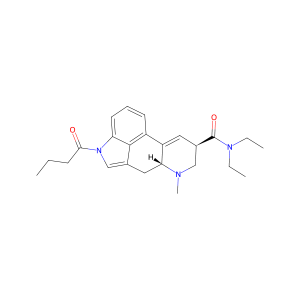
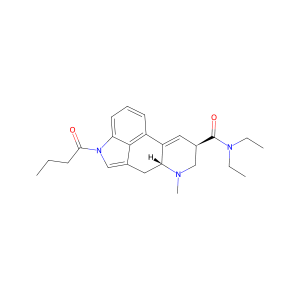
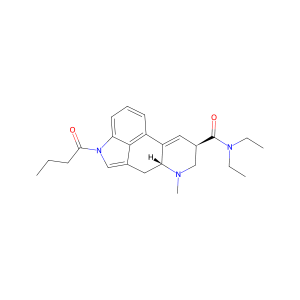
1B-LSD, also known as 1-butanoyl-LSD or 1-butanoyl-d-lysergic acid diethylamide, is an N1-acyl derivative of LSD. A butanoyl group is attached to the indole nitrogen of the lysergamide structure, where LSD itself carries a hydrogen atom. The compound is closely related to 1P-LSD, but the side chain is one carbon longer. It is also a constitutional isomer of 1P-ETH-LAD: the two have the same molecular formula, although the positions of their structural changes are different.
Chemistry and identification
The distinction between 1B-LSD and 1P-ETH-LAD is easy to miss if attention is limited to their overall composition. In 1B-LSD, the N1 substituent is butanoyl and the N6 position retains the methyl group found in LSD. In 1P-ETH-LAD, the N1 group is propionyl, while the N6 methyl has been replaced by an ethyl group. These changes produce two different molecular arrangements, not two names for the same substance.
In their 2019 analytical characterization of 1B-LSD, Brandt and colleagues compared its spectra with those of 1P-ETH-LAD. Nuclear magnetic resonance, infrared spectroscopy, mass spectrometry and chromatography revealed differences that allow the two isomers to be distinguished. In forensic work, a mass value on its own may be insufficient when two structures share the same formula.
The researchers also tested 1B-LSD in the mouse head-twitch response (HTR), a behavioural assay commonly used to investigate psychedelic-like activity associated with 5-HT2A receptor activation. The compound produced a dose-dependent response, but its estimated potency was about 14% of LSD’s in that experiment. That figure describes relative activity in a particular mouse model; it is not a human potency estimate.
Metabolism and the relationship to LSD
The mouse response alone cannot show whether the intact molecule is responsible for the behaviour or whether LSD formed after metabolism contributes to it. That question has to be considered separately from the HTR result.
More direct evidence came from Wagmann and colleagues’ in-vitro investigation of nine lysergamides. Using pooled human liver S9 fractions, they found that 1B-LSD underwent deacylation to LSD. N-dealkylation and hydroxylation were also among the metabolic routes observed across the compounds, with CYP1A2 and CYP3A4 contributing to several initial reactions. These are laboratory findings from a liver preparation, not a measurement of the rate or extent of conversion in a living person.
Taken together, the animal and metabolic studies make an LSD-related mechanism plausible. They do not establish how much intact 1B-LSD reaches the brain, how quickly it is converted in humans or whether the parent compound contributes independently to its effects.
Reported effects
The accounts summarized in PsychonautWiki’s 1B-LSD entry tend to place the experience close to LSD, although users often describe it as particularly energetic and fast-moving. The reported effects cover several parts of the experience.
| Physical and visual effects | Cognitive and emotional effects |
|---|---|
|
|
These accounts are anecdotal. They do not establish how often each effect occurs, and they cannot determine whether the experience is produced by 1B-LSD itself, by LSD formed after hydrolysis or by both.
Forensic detection
One practical consequence of the proposed conversion is that biological samples may contain LSD even when the original exposure was to 1B-LSD. Wagmann and colleagues also found that several lysergamides can form metabolites that are structurally identical to those produced by other members of the group. Detecting LSD or a shared metabolite therefore does not always reveal which precursor was present.
1B-LSD has been identified in seized blotter material. In a 2020 customs investigation, Tsochatzis and colleagues used an integrated analytical workflow to identify 1B-LSD in a Swedish seizure, combining gas chromatography–mass spectrometry, high-resolution mass spectrometry and NMR. The work illustrates why a product label or the appearance of a blotter cannot establish its chemical contents.
For 1B-LSD, the main unresolved questions concern its behaviour in humans: the extent and timing of conversion, the contribution of the intact compound and the range of possible adverse reactions. The laboratory evidence supports an LSD-related metabolic pathway, but it does not provide a complete clinical picture.
1B-LSD Products
Scientific Data
Identity and Structure
| Chemical Name | 1B-LSD |
|---|---|
| Catalog Entity Type | Compound |
| Formula | C24H31N3O2 |
| Molar Mass | 393.531 g·mol−1 |
| CAS | 2349376-12-9 |
| CAS Numbers and Substance Forms | 2349376-12-9 |
| Synonyms | 1-Butyryl-LSD; X-LSD |
| IUPAC Name | (6aR,9R)-N,N-diethyl-6-methyl-4-butanoyl-4,6,6a,7,8,9-hexahydroindolo[4,3-fg]quinoline-9-carboxamide |
| InChI | InChI=1S/C24H31N3O2/c1-5-9-22(28)27-15-16-13-21-19(18-10-8-11-20(27)23(16)18)12-17(14-25(21)4)24(29)26(6-2)7-3/h8,10-12,15,17,21H,5-7,9,13-14H2,1-4H3/t17-,21-/m1/s1 |
| InChIKey | SVRFNPSJPIDUBC-DYESRHJHSA-N |
| SMILES | CN1[C@](C2=C[C@@H](C(N(CC)CC)=O)C1)([H])CC3=CN(C(CCC)=O)C4=C3C2=CC=C4 |
Chemical Identifiers
| PubChem CID | 145875086 |
|---|---|
| ChemSpider ID | 82827098 |
| UNII | Y6JQX3L6LP |
Clinical Data
| Drug Class | Serotonergic psychedelic; Hallucinogen |
|---|---|
| Routes of Administration | Oral |
Legal Status
| Legal Status (Wikipedia Source Text) | AU: S8 (Controlled drug) BR: Class F2 (Prohibited psychotropics) CA: Unscheduled DE: NpSG (Industrial and scientific use only) UK: Under Psychoactive Substances Act US: Unscheduled (may be covered by the Federal Analogue Act if sold for human consumption) UN: Unscheduled |
|---|
Sources and Attribution
| Wikipedia Source URL | https://en.wikipedia.org/?curid=64107135 |
|---|