1P-ETH-LAD
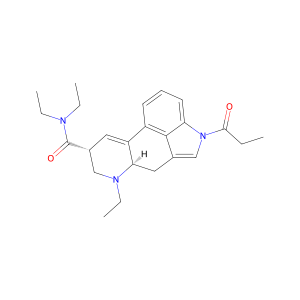
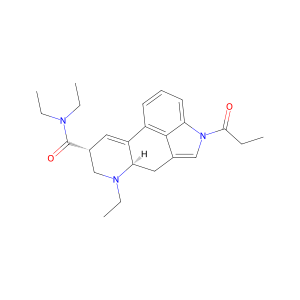
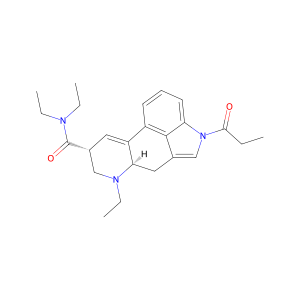
1P-ETH-LAD, also known as 1-propionyl-ETH-LAD or 1-propionyl-6-ethyl-6-nor-lysergic acid diethylamide, is an N1-acyl derivative of ETH-LAD. It combines the N6-ethyl substitution of ETH-LAD with a propionyl group attached to the indole nitrogen. It is therefore related to both ETH-LAD and 1P-LSD, but differs from each at a specific position of the lysergamide structure.
Structure and analytical characterization
In LSD, the N6 position carries a methyl group. ETH-LAD has an ethyl group at that position, while 1P-ETH-LAD retains the ethyl substituent and adds a propionyl group at N1. This is different from 1P-LSD, which carries the same N1-propionyl group but retains LSD’s N6-methyl group.
The distinction also explains why 1P-ETH-LAD is a constitutional isomer of 1B-LSD. In 1B-LSD, the N1 group is butanoyl and N6 remains methyl. In 1P-ETH-LAD, the N1 group is propionyl and N6 is ethyl. Brandt and colleagues characterized both compounds in separate studies, using mass spectrometry, chromatography and NMR to distinguish their structures.
Brandt and colleagues included an incubation experiment in their 2017 analytical study of ETH-LAD and 1P-ETH-LAD. When 1P-ETH-LAD was incubated with human serum at 37°C, ETH-LAD was already detectable at the first sampling point, one hour after incubation began. The parent compound was still present after 24 hours. This supports a possible conversion to ETH-LAD, but does not show how the process unfolds in a living person.
Metabolism and pharmacological evidence
There is no comparable controlled human pharmacokinetic study for 1P-ETH-LAD, and no direct receptor study has established its activity at 5-HT2A. A prodrug role is plausible, although it may not fully explain the compound’s pharmacology. It remains possible that the intact compound has activity of its own or that the time course of conversion differs between an in-vitro serum preparation and the human body.
Reported effects
The descriptions gathered in PsychonautWiki’s 1P-ETH-LAD entry compare the experience with ETH-LAD and AL-LAD, but emphasize its visual and cognitive character. The accounts are anecdotal, and the entry itself notes that the effects section is incomplete.
| Physical and visual effects | Cognitive and emotional effects |
|---|---|
|
|
Some users describe the experience as less emotionally charged than LSD, while others report discomfort or anxiety. Since conversion to ETH-LAD has only been examined in vitro, the available evidence cannot show whether the reported effects are produced by 1P-ETH-LAD itself, ETH-LAD formed after exposure or both.
1P-ETH-LAD Products
Scientific Data
Identity and Structure
| Chemical Name | 1P-ETH-LAD |
|---|---|
| Catalog Entity Type | Compound |
| Formula | C24H31N3O2 |
| Molar Mass | 393.531 g·mol−1 |
| CAS | 2230715-45-2 |
| CAS Numbers and Substance Forms | 2230715-45-2 |
| Synonyms | 1-Propionyl-ETH-LAD; 1-Propionyl-6-ethyl-6-nor-LSD |
| IUPAC Name | (6aR,9R)-N,N-Diethyl-7-ethyl-4-propanoyl-6,6a,8,9-tetrahydroindolo[4,3-fg]quinoline-9-carboxamide |
| InChI | InChI=1S/C24H31N3O2/c1-5-22(28)27-15-16-13-21-19(18-10-9-11-20(27)23(16)18)12-17(14-26(21)8-4)24(29)25(6-2)7-3/h9-12,15,17,21H,5-8,13-14H2,1-4H3/t17-,21-/m1/s1 |
| InChIKey | MLOFCBXSOAYCIF-DYESRHJHSA-N |
| SMILES | CCC(=O)N1C=C2C[C@@H]3C(=C[C@H](CN3CC)C(=O)N(CC)CC)C4=C2C1=CC=C4 |
Chemical Identifiers
| PubChem CID | 119025859 |
|---|---|
| ChemSpider ID | 52085137 |
| UNII | HA76076A0R |
| CompTox DTXSID | DTXSID301016300 |
Clinical Data
| Drug Class | Serotonergic psychedelic; Hallucinogen |
|---|---|
| Routes of Administration | Oral |
Legal Status
| Legal Status (Wikipedia Source Text) | DE: NpSG (Industrial and scientific use only) UK: Under Psychoactive Substances Act Illegal in France |
|---|
Sources and Attribution
| Wikipedia Source URL | https://en.wikipedia.org/?curid=56708836 |
|---|