1cP-LSD
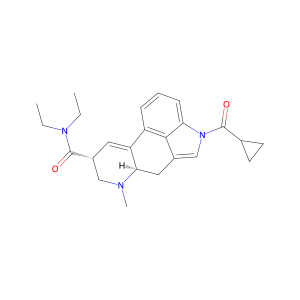
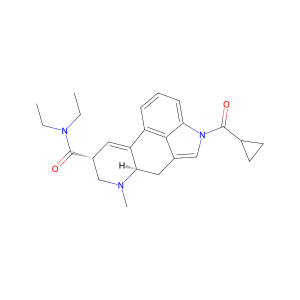
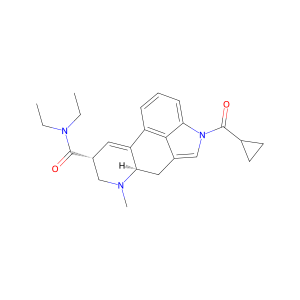
1cP-LSD, also known as 1-cyclopropanoyl-LSD or 1-cyclopropanecarbonyl-LSD, is an N1-acyl derivative of lysergic acid diethylamide. A cyclopropanecarbonyl group is attached to the indole nitrogen of the LSD scaffold. This places it in the same broad family as 1P-LSD and 1B-LSD, although the group attached at N1 is structurally different in each compound.
Chemistry and analytical identification
The cyclopropanecarbonyl substituent gives 1cP-LSD a compact ring-containing side chain rather than the straight-chain propionyl group found in 1P-LSD. The change may look modest when the structures are drawn side by side, but it creates a distinct compound and can influence both analytical behaviour and metabolism.
In their 2020 analytical characterization of 1cP-LSD, Brandt and colleagues used several mass-spectrometric, chromatographic and spectroscopic techniques, including NMR, and examined blotter and pellet samples. Gas chromatography also produced degradation products, showing that the analytical conditions themselves can alter this compound before it is detected.
In the same investigation, incubation of 1cP-LSD with human serum led to the formation of LSD. The signal associated with the hydrolysis product increased across the observation period, which included measurements up to 24 hours. This supports the possibility that 1cP-LSD can act as a prodrug, but it does not establish the rate of conversion in a living person.
Behavioural activity
In mice, 1cP-LSD was examined using the head-twitch response (HTR), a behavioural model associated with 5-HT2A receptor activation. The compound produced a dose-dependent increase in head-twitch behaviour. Its estimated ED50 was 430 nmol/kg, compared with 132.8 nmol/kg for LSD in the reference experiment. On that basis, 1cP-LSD showed about 31% of LSD’s potency in this particular assay. Its activity was similar to that previously measured for 1P-LSD in the same model.
The values allow a comparison under controlled animal-test conditions, but they are not a direct measure of relative human potency. The authors noted that clinical research would be needed to establish the potency and qualitative effects of 1cP-LSD in people.
Reported effects
The reports collected in PsychonautWiki’s 1cP-LSD entry generally compare the experience with LSD. Visual patterns, colour enhancement, changes in depth and perspective, time distortion and shifts in thought are among the recurring descriptions. Stimulation and increased attention to music are also mentioned. Some users describe a smoother physical and cognitive experience, but this impression has not been tested in a controlled human comparison.
| Reported perceptual effects | Reported physical and cognitive effects |
|---|---|
|
|
The table draws on anecdotal descriptions that have not been clinically validated. It does not show how frequently each effect occurs, nor whether the effects are produced by 1cP-LSD itself or by LSD formed after hydrolysis.
Metabolism and interpretation of toxicology results
The conversion of 1cP-LSD to LSD has an important consequence for forensic testing. If the parent compound is hydrolysed before or during sample analysis, a laboratory may detect LSD without being able to identify which N1-acyl derivative was originally present. The 2020 study’s observation of degradation products during gas chromatography reinforces the need to consider sample preparation and instrument conditions when interpreting results.
The authors also pointed out that carboxylesterases are present in red blood cell membranes but not in serum, so conversion in the body could be faster than the serum experiment suggests. That remains an explanation for the difference between the in-vitro result and a possible in-vivo process, not a direct measurement of 1cP-LSD pharmacokinetics in people.
Unlike 1P-LSD, which has been examined in a small human pharmacokinetic study, 1cP-LSD has not been studied under controlled conditions in people. Its subjective profile is therefore still based mainly on user accounts.
1cP-LSD Products
Scientific Data
Identity and Structure
| Chemical Name | 1cP-LSD |
|---|---|
| Catalog Entity Type | Compound |
| Formula | C24H29N3O2 |
| Molar Mass | 391.515 g·mol−1 |
| CAS | 2767597-50-0 |
| CAS Numbers and Substance Forms | 2767597-50-0 |
| Synonyms | 1-CPA-LSD; 1-Cyclopropanoyl-LSD; 1-Cyclopropionyl-LSD; 1-(Cyclopropylmethanoyl)-LSD; 1cP; Curie |
| IUPAC Name | (6aR,9R)-N,N-diethyl-7-methyl-4-cyclopropylmethanoyl-4,6,6a,7,8,9-hexahydroindolo[4,3-fg]quinoline-9-carboxamide |
| InChI | InChI=1S/C24H29N3O2/c1-4-26(5-2)23(28)17-11-19-18-7-6-8-20-22(18)16(12-21(19)25(3)13-17)14-27(20)24(29)15-9-10-15/h6-8,11,14-15,17,21H,4-5,9-10,12-13H2,1-3H3/t17-,21-/m1/s1 |
| InChIKey | RAFUPYYDHPFASC-DYESRHJHSA-N |
| SMILES | CCN(CC)C(=O)[C@@H]5C=C2[C@@H](Cc3cn(C(=O)C1CC1)c4cccc2c34)N(C)C5 |
Chemical Identifiers
| PubChem CID | 155884675 |
|---|---|
| ChemSpider ID | 107450612 |
| UNII | 7UU7S6TN3J |
Clinical Data
| Drug Class | Serotonergic psychedelic; Hallucinogen |
|---|---|
| Routes of Administration | Oral |
Pharmacokinetics
| Duration of Action | 5–10 hours |
|---|
Legal Status
| Legal Status (Wikipedia Source Text) | AU: S9 (Prohibited substance) BR: Class F2 (Prohibited psychotropics) CA: Unscheduled. DE: NpSG (Industrial and scientific use only) UK: Under Psychoactive Substances Act |
|---|
Sources and Attribution
| Wikipedia Source URL | https://en.wikipedia.org/?curid=64093435 |
|---|