What is 4-HO-MPT?
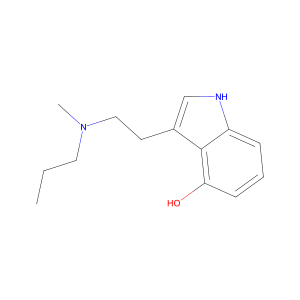
4-HO-MPT, also known as Meprocin, is a synthetic psychedelic tryptamine. Its chemical name is 4-hydroxy-N-methyl-N-propyltryptamine. It is structurally related to psilocin and other 4-hydroxy tryptamines, but carries a methyl and a propyl group on the terminal nitrogen rather than the two methyl groups found in psilocin. The compound should not be confused with 4-HO-MiPT, or Miprocin: the two names are similar, but their N-alkyl substituents are different.
Chemical background
Meprocin was described in the early literature on substituted tryptamines and later appeared in Alexander and Ann Shulgin’s TiHKAL. The Shulgins’ account was brief, reflecting the limited observations available at the time. Subsequent national forensic and scientific assessments have documented its chemical identity and receptor activity, although the human evidence remains much thinner than for psilocin or LSD.
The distinction between Meprocin and Miprocin matters when interpreting online descriptions. Replacing an isopropyl group with a straight-chain propyl group changes the molecule’s shape and may affect its interactions with receptors and transporters. Findings for one compound should therefore not be transferred to the other without direct evidence.
Pharmacology
4-HO-MPT has been included in laboratory studies of substituted tryptamines. Glatfelter and colleagues measured its binding at a panel of human receptors in 2023. The compound showed affinity at 5-HT2A, 5-HT2C and several other targets, including the serotonin transporter. In their binding assay, its measured 5-HT2A inhibition constant was 114 nM. Binding affinity indicates how readily a compound interacts with a receptor; it does not, by itself, show how strongly the receptor is activated.
Functional studies have also reported agonist activity at 5-HT2A. A Swedish forensic assessment of 4-HO-MPT summarized an in-vitro experiment in which the compound acted as a full agonist, although its EC50 was substantially higher than that of LSD in the same assay. Values from different laboratories are not directly comparable: receptor expression, assay design and measured endpoint can all affect the result. The broader receptor data are published in Glatfelter et al. (2023).
Reported effects
Human descriptions of Meprocin are limited. Shulgin’s brief account in TiHKAL records visual changes and dizziness, while later reports describe effects more broadly associated with 4-substituted tryptamines. The available material is too sparse to establish a characteristic time course or a reliable distinction from other compounds in the same family.
Reports mention colour enhancement, visual distortions, changes in sound perception and a sense of euphoria. Some users describe a more physical or dizzying experience than they expected from a psilocin-like tryptamine. Nausea, tension and anxiety are also possible. These descriptions remain anecdotal, without clinical validation.
Research limitations
4-HO-MPT has measurable activity at serotonin receptors, but its human pharmacology is not well characterized. There is little controlled information about absorption, metabolism, duration or the relationship between exposure and subjective effects. Its structural similarity to Miprocin and psilocin helps frame the questions researchers might ask, but it does not answer them.
4-HO-MPT Products
Scientific Data
Identity and Structure
| Chemical Name | 4-HO-MPT |
|---|---|
| Catalog Entity Type | Compound |
| Formula | C14H20N2O |
| Molar Mass | 232.327 g·mol−1 |
| CAS | 763035-03-6 77872-42-5 |
| CAS Numbers and Substance Forms | 763035-03-6 (free base) 77872-42-5 (hydrochloride) |
| Synonyms | 4-OH-MPT; 4-Hydroxy-N-methyl-N-propyltryptamine; Meprocin |
| IUPAC Name | 3-[2-[methyl(propyl)amino]ethyl]-1H-indol-4-ol |
| InChI | InChI=1S/C14H20N2O/c1-3-8-16(2)9-7-11-10-15-12-5-4-6-13(17)14(11)12/h4-6,10,15,17H,3,7-9H2,1-2H3 |
| InChIKey | XFQDDPQGBLSNCN-UHFFFAOYSA-N |
| SMILES | OC1=CC=CC2=C1C(CCN(C)CCC)=CN2 |
Chemical Identifiers
| PubChem CID | 21786584 |
|---|---|
| ChemSpider ID | 10513074 |
| UNII | 37A55H0XW4 |
| CompTox DTXSID | DTXSID90904008 |
Clinical Data
| Drug Class | Non-selective serotonin receptor agonist; Serotonin 5-HT2A receptor agonist; Serotonergic psychedelic; Hallucinogen |
|---|---|
| Routes of Administration | Oral |
| ATC Code | None |
Sources and Attribution
| Wikipedia Source URL | https://en.wikipedia.org/?curid=11679802 |
|---|