What is PARGY-LAD?
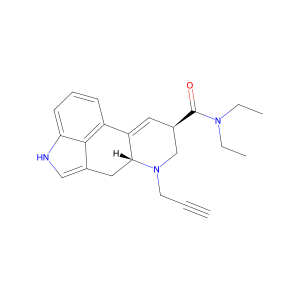
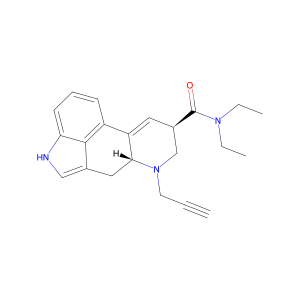
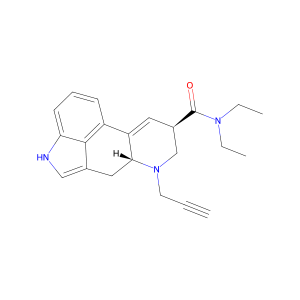
PARGY-LAD, also written as PARGYLAD, 6-propynyl-6-nor-LSD or N-propargyl-nor-LSD, is a synthetic lysergamide related to LSD. It carries a propargyl substituent at the N6 position of the ergoline structure, where LSD has a methyl group. The propargyl group contains a carbon–carbon triple bond, distinguishing PARGY-LAD from PRO-LAD, which carries a saturated propyl group at the same position.
Origin and chemical relationship to LSD
PARGY-LAD belongs to the series of N6-substituted norlysergic acid diethylamides investigated by Andrew Hoffman and David Nichols at Purdue University during the 1980s. The aim of this work was to examine how changes to the N6 substituent affected LSD-like activity. The series included ethyl, allyl, propyl, isopropyl, butyl and propargyl derivatives.
The structural difference between PARGY-LAD and PRO-LAD is easy to overlook because both names refer to three-carbon substituents. They are not the same group: propargyl contains an alkyne, while propyl is a saturated alkyl chain. The distinction matters because the 1985 structure–activity study found markedly different behavioural potency for the two derivatives.
Pharmacological evidence
Hoffman and Nichols tested N6-substituted lysergamides in rats trained to distinguish LSD from saline. The propargyl derivative showed LSD-like stimulus activity, but was approximately an order of magnitude less potent than LSD in the drug-discrimination assay. This is direct preclinical evidence that PARGY-LAD can produce an LSD-related behavioural cue in rats, although at substantially lower potency in that model.
The findings do not establish a human potency ratio. Drug discrimination measures whether an animal responds to a compound as resembling a training drug; it does not measure the quality or intensity of a human psychedelic experience. Hoffman and Nichols reported the series in their 1985 study of N6-alkyl norlysergic acid diethylamide derivatives. The accompanying Purdue dissertation on the synthesis and pharmacological evaluation of the series gives the more detailed structure–activity results for the propargyl analogue.
Human observations
PARGY-LAD has no substantial human research record. The available historical comments are brief and appear in the extension to Shulgin’s PRO-LAD entry in TiHKAL, rather than in a separate chapter. Shulgin noted some activity at a lower tested amount and a clearer response at a higher one, but these observations were not part of a controlled clinical study. They provide limited evidence that the compound was explored by self-experimentation, not a reliable description of its effects.
The animal study establishes a measurable LSD-like cue in rats under laboratory conditions. The historical human observations are anecdotal and too limited to define onset, duration, dose-response or the character of the experience. Shulgin’s comments are preserved in TiHKAL, entry #51: PRO-LAD, including its discussion of PARGY-LAD.
Reported effects and safety
Human observations of PARGY-LAD are too limited to establish its characteristic effects. Its lysergamide structure and the rat drug-discrimination result make comparison with LSD reasonable at a broad pharmacological level, but they do not show that its subjective effects are identical. Claims about typical visual effects, duration or relative manageability would go beyond the evidence.
No dedicated human pharmacokinetic, metabolic or clinical toxicology study has established how PARGY-LAD is processed or what adverse effects may occur. The available evidence supports its chemical identity and LSD-like behavioural activity in rats, while leaving its human pharmacology largely unresolved.
PARGY-LAD Products
Scientific Data
Identity and Structure
| Chemical Name | PARGY-LAD |
|---|---|
| Catalog Entity Type | Compound |
| Formula | C22H25N3O |
| Molar Mass | 347.462 g·mol−1 |
| CAS | 2767597-51-1 |
| CAS Numbers and Substance Forms | 2767597-51-1 |
| Synonyms | PARGYLAD; PROPARGYL-LAD; PROPARGYLLAD; 6-Propynyl-6-nor-LSD; N,N-Diethyl-6-propargyl-6-norlysergamide; N,N-Diethyl-6-(prop-2-yn-1-yl)-9,10-didehydroergoline-8β-carboxamide |
| IUPAC Name | (6aR,9R)-N,N-diethyl-7-prop-2-ynyl-6,6a,8,9-tetrahydro-4H-indolo[4,3-fg]quinoline-9-carboxamide |
| InChI | InChI=1S/C22H25N3O/c1-4-10-25-14-16(22(26)24(5-2)6-3)11-18-17-8-7-9-19-21(17)15(13-23-19)12-20(18)25/h1,7-9,11,13,16,20,23H,5-6,10,12,14H2,2-3H3/t16-,20-/m1/s1 |
| InChIKey | BPJKJUFQSNRQCR-OXQOHEQNSA-N |
| SMILES | CCN(CC)C(=O)[C@@H]2C=C1c3cccc4[nH]cc(C[C@H]1N(C2)CC#C)c34 |
Chemical Identifiers
| PubChem CID | 139030999 |
|---|---|
| ChemSpider ID | 21106360 |
| CompTox DTXSID | DTXSID501045856 |
Clinical Data
| Drug Class | Serotonin receptor modulator; Serotonergic psychedelic; Hallucinogen |
|---|---|
| Routes of Administration | Oral |
Legal Status
| Legal Status (Wikipedia Source Text) | DE: NpSG (Industrial and scientific use only) UK: Under Psychoactive Substances Act Illegal in France |
|---|
Sources and Attribution
| Wikipedia Source URL | https://en.wikipedia.org/?curid=5837156 |
|---|